September 19, 2010 0

4×4 Project 3

By in Major Studio: Interface

Concept: Create a forum for Repurposing project ideas

Strategy: Build a website to post project ideas, create a community for repurpose-ers

Manifestation:
I purchased the domain “repurpose.cc” to make sure that I can realize this project in the future, and at a convenient domain name. My original structure for the site can be seen on the sitemap. A mock-up of the home page can be seen at repurpose.cc. I plan to design the site in html and explore how to build a social network.

Tags: , , ,

September 19, 2010 0

4×4 Project 2

By in Major Studio: Interface

Concept: Inspired by The Cut-Up Method of Brion Gysin, by William S. Burroughs, I decided to write an all-encompassing Manifesto for designers.

Strategy: This Manifesto would be a combination of three other Manifestos:

  • The Repair Manifesto by Platform 21, which encourages design of products and systems that are repairable and thus live extensive, meaningful lives.
  • The Maker’s Bill of Rights by Make Magazine, which encourages open-source electronics and design.
  • And a summary of The Communist Manifesto, the influential document outlining the Communist party’s beliefs.

These three Manifestos, while different in content and meaning, all encompass similar ideals: making things accessible to the masses and long lasting.

Manifestation:
I started by rearranging each Manifesto separately, by using Burroughs first suggestion:

The method is simple. Here is one way to do it. Take a page. Like this page. Now cut down the middle and cross the middle. You have four sections: 1 2 3 4 . . . one two three four. Now rearrange the sections placing section four with section one and section two with section three. And you have a new page.

I then cut up each Manifesto, leaving each point in tact. I was left with a pile of strips of paper, which I arranged randomly to get my new Manifesto.

Read the rest of this entry »

Tags: , , ,

September 19, 2010 0

4×4 Project 1

By in Major Studio: Interface

Concept: Re-purposing massive waste due to too many shipping boxes.

Strategy: Use received cardboard boxes for a new purpose

Manifestation:
I received 5 boxes in the mail this week.  Normally when I have things shipped to me, I ask that all of my items from one store be shipped together to use less packaging and postage.  This week, for some reason, both of the online outlets I ordered from (both the mega-online book and mega-electronics stores will remain nameless), decided to ship my items in as many boxes necessary to get my items to me faster.  To be honest, I would have appreciated more if the stores would have honored my request for less packaging, even if it meant receiving my items later.

Read the rest of this entry »

Tags: , , , ,

September 19, 2010 1

Hello world!

By in Uncategorized

Welcome to WordPress. This is your first post. Edit or delete it, then start blogging!

September 17, 2010 0

Getting to Simon

By in Physical Computing 1

Our assignment this week for PComp is to recreate the hand-held game Simon.

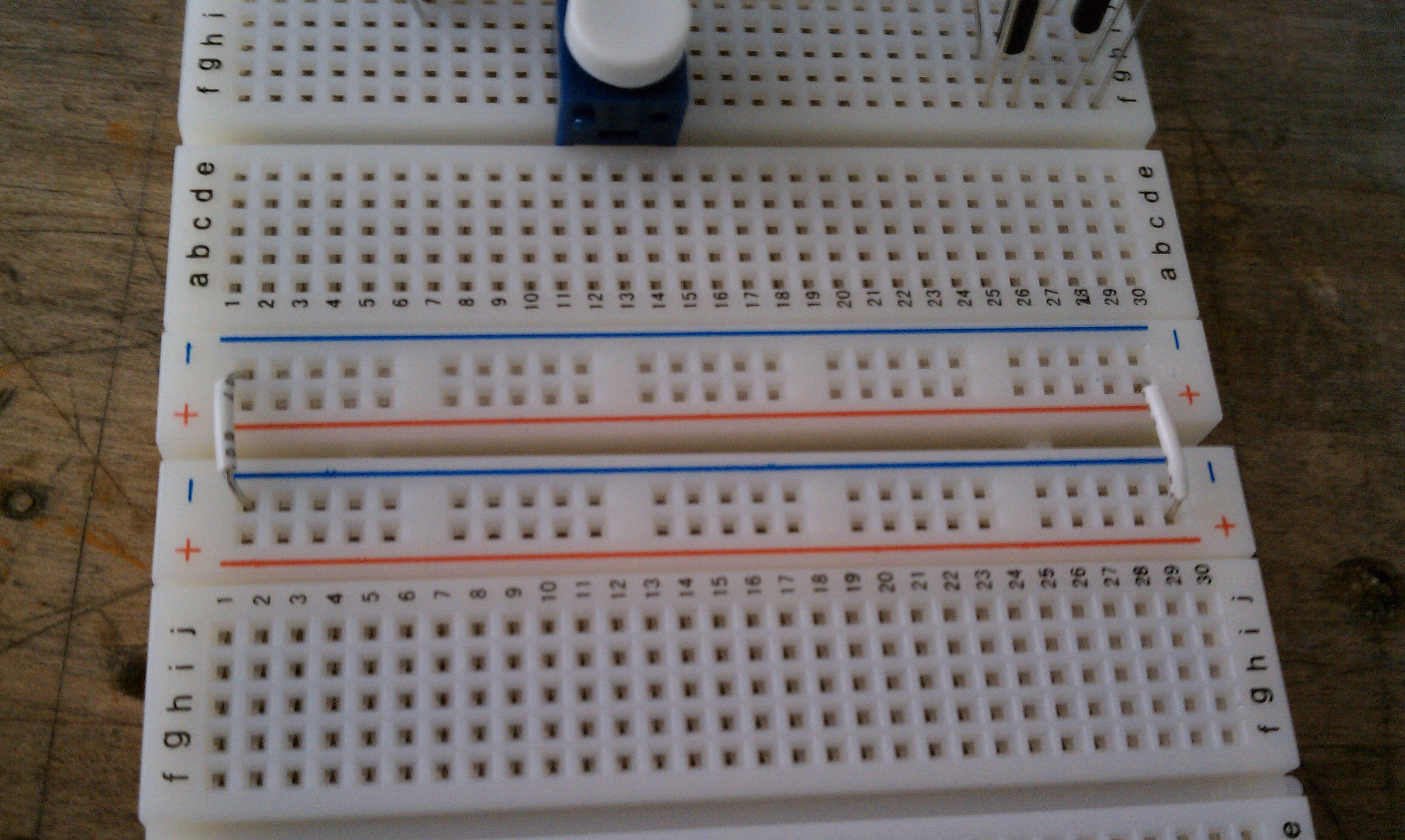
To start, I decided to use two breadboards in order to make room for four buttons and four LEDs.  I attached the two together by connecting a wire from board one’s red line to board two’s, and the same with the blue lines.
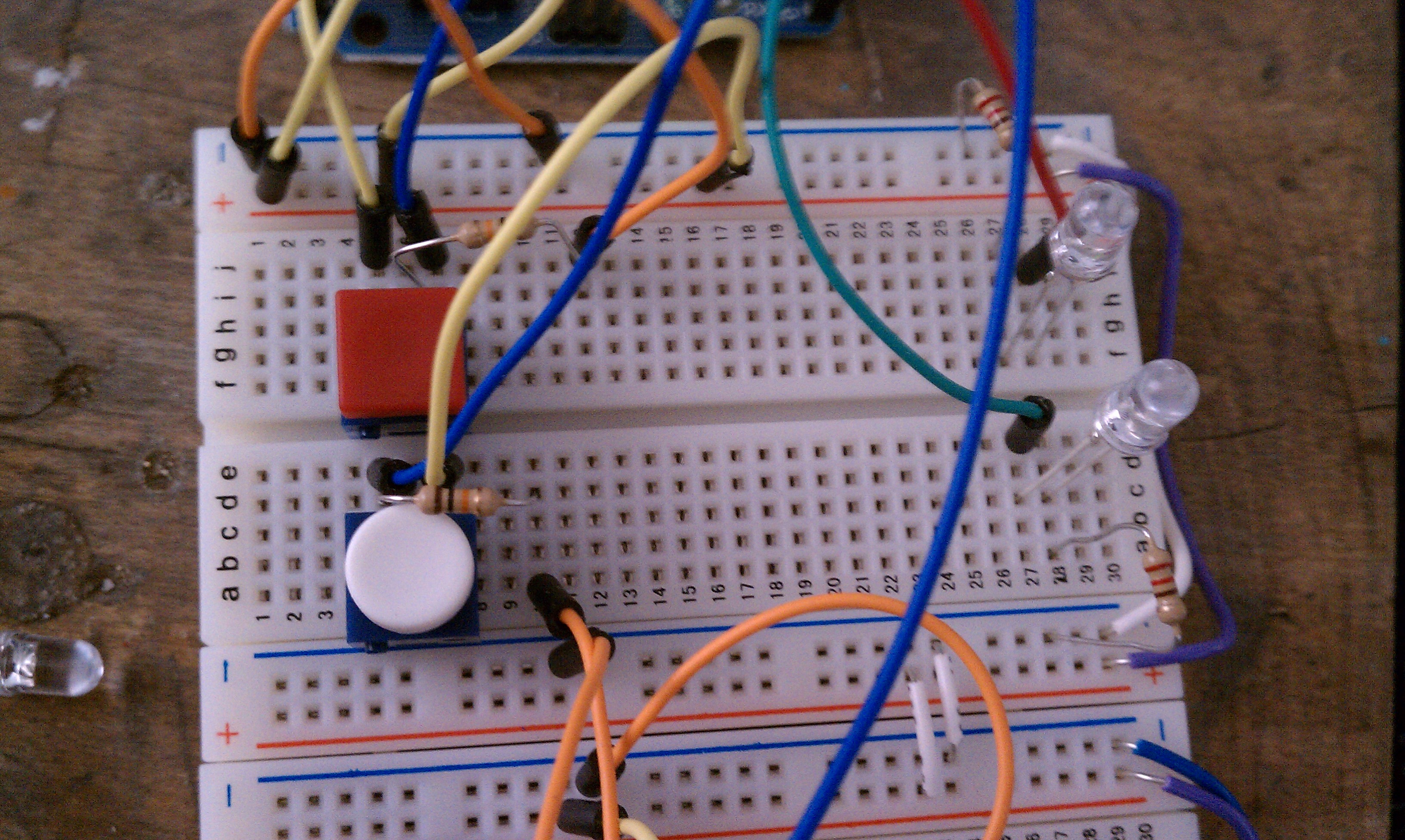
Next, I set up two buttons to control two separate LEDs.
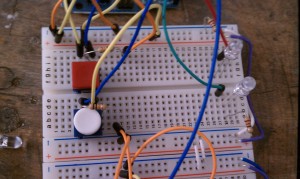
Here is a video showing how this works.

buttons turn on LEDS from Tami on Vimeo.

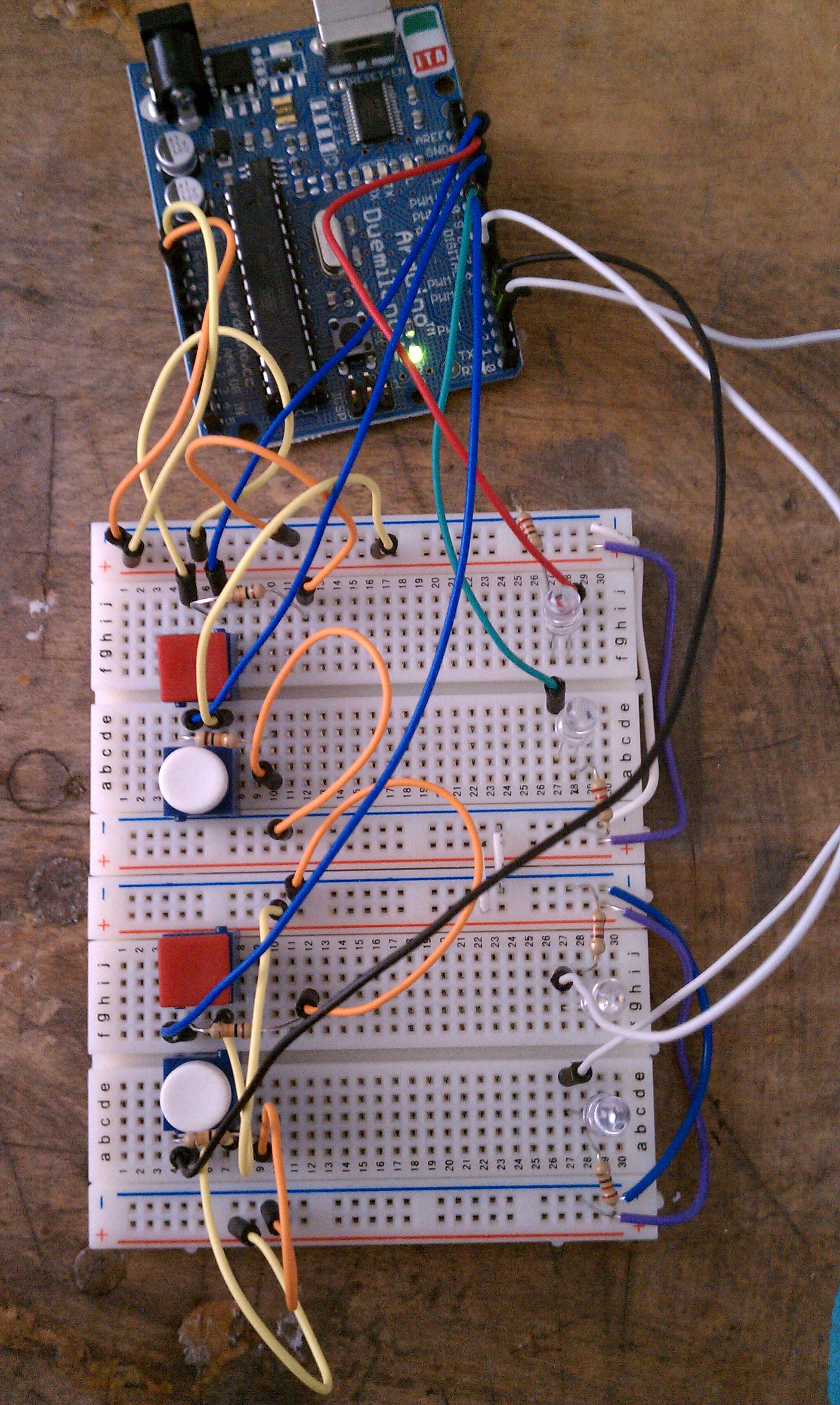
Here is the board wired with four buttons, four LEDs and attached to the Arduino, ready to be programmed.
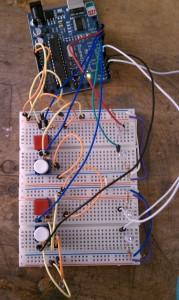
After playing around with the code, I was able to get the four LEDs to light up randomly.

random LEDs light up from Tami on Vimeo.

I am currently trying to figure out how to get the Arduino to memorize the random sequence of LEDs, and then to try to mimic that sequence with button presses to finish the game.

UPDATE
I’m still stuck at getting my output to affect my input to affect my output, to get Simon to work.  My circuits are running smoothly, but my code is not!

For now I’m stuck here.  I’m able to get the sample code posted here to work, but I want to figure out how to write it in my own words.  My code can be found here.

Tags: , ,

September 17, 2010 0

Red Light Green Light

By in Physical Computing 1

I figured out how to get my breadboard and Arduino to interact.  Below is a video showing what I worked on tonight.  I got the red LED to blink on the first button press, then the green LED to blink on the second button press, then back to red, then green, etc.  This was done using conditional statements and a button counter.

Red Light Green Light from Tami on Vimeo.

Tags: ,

September 17, 2010 0

Reading Thoughts

By in Major Studio: Interface

Spheres Theory
by Peter Sloterdijk

As humans, we are functions of our inner-selves.  We form a relationship with ourself (made up of inner parts), and we look for what we lack internally with others.  We create spheres, or boundaries, for ourselves.  Our spheres touch others’ spheres, but we are also isolated from them by the walls of our sphere.  Sloterdijk gives the example of a modern apartment building.  Each apartment was designed for a single dweller.  The apartment walls shelter us from the noise and disruption created by others, yet we still share walls and there is an outer boundary that contains us.  

Our space is defined by our memory of previous space we occupied.  This idea also explains why we became home-dwellers in the first place.  Inside space was originally derived from the need, in agricultural terms, to wait for the crops to mature and bear fruit.  In waiting, we created a habit of being inside.  While we are now less patient, we are habitual home-dwellers, made so by our collective memory of the previous space “we” occupied, waiting for the crops to mature.

I think Sloterdijk has made an interesting point here.  We are products of our inner-selves in the context of others.  Without others around us, our fragile bubble would burst and we would be nothing.  Yet, our bubble protects us from the dangers and annoyances of the outside world and we are able to relax and reflect on our own.

It is our job as designers to keep this notion in mind when creating experiences for users.  User experience is relational to previous experiences of the user and each user occupies their own space, relational to others.  We must design experiences where the user is comfortable in their own thoughts, and where they are protected as they interact with others.

September 17, 2010 0

Lesson Learned

By in Uncategorized

Hey people, BACK UP YOUR WORK. I thought I had learned this lesson vicariously through Rend during Bootcamp, yet I still managed to delete my entire blog earlier this evening. Thanks to the brother, databases, and this here back-up blog for your ability to store and recover otherwise deleted data. Without you, a week’s worth of thoughts and work would have been but a in-accessible memory.

Tags: , , ,

September 12, 2010 0

I Love NY – Findings

By in Sourcemap

After completing our research, Liz and I created a map and video illustrating our findings.

I <3 NY from liz kauff on Vimeo.

and don’t forget to check out the map, showing the life cycle of a I Love NY t-shirt.

Tags: , , ,

September 12, 2010 0

Zone of the Impending – Research

By in Uncategorized

After doing our own research for our upcoming Interface project, Zone of the Impending, Larry, Monica, and I have compiled an interesting set of sources. From news articles to art installations to global projects, these sources provide excellent background and inspiration to begin crafting our project.

Where does our waste go?
The Story of Stuff
Plastic and trash
E-waste
Ocean and trees

How do we visualize data?
Cartographic curiosities
A different world
Flowing data

How can we make people interested in all of this?
The Fun Theory
Energy consumption

Tags: , , ,

September 12, 2010 0

I Love NY – Sourcemap

By in Fall 2010, Sourcemap

I created a sweet Google Map of the production process of your typical I Love NY t-shirt. The map will be updated as we find even more specific details of the process.

Check it out!

I organized the steps in production by the following colors:
Blue – Production
Yellow – Sale
Pink – Consumption

September 12, 2010 0

Designing Responsibly

By in Fall 2010, Major Studio: Interface, Physical Computing 1, Sourcemap

One over-arching theme in all of my classes this semester is designing responsibly. In Sourcemap, we focus on where things come from, in Physical Computing we talk about where things are going, and in my Major Studio we were charged with thinking about our impact on the world both as people and designers.

We watched this video for PComp, but it provides food for thought in all of my classes, and in my life.

An interesting article that I read this week talks about where our plastic goes once we consider it junk and throw it away. This article came out in 2007, yet we don’t seem to be caring so much about the problem today.

Both of these examples give me inspiration to solve these problems, but they are massive problems that can only be solved by mass behavioral change in our world.

Tags: , ,